
Lee Federal Release Boundaries
No Bureau of Prisons institution or designated ICE detention center was identified inside Lee County during the official facility review. That fact does not mean a person tied to a Lee County case is free. The U.S. Marshals Service can place pretrial and presentence defendants in contract facilities outside the county. BOP becomes the main public locator after a sentenced person enters its custody. ICE uses a separate immigration detention system.
A Lee County jail record can prove a local episode and show a transfer to another agency. It cannot conclusively prove what happened after federal officers accepted custody. “Released” from the county jail may describe the end of Sheriff custody only. Follow the receiving agency named in the local detail and the federal case stage before describing the person’s current status.
| Custody class | Best first source | What it cannot prove alone |
|---|---|---|
| Sentenced federal person | BOP Inmate Locator | USMS, ICE, state, or local custody outside BOP |
| Federal pretrial defendant | Federal case and relevant USMS district | Later BOP entry or immigration detention |
| Adult immigration detainee | ICE Online Detainee Locator and ERO | Criminal case result or non-ICE custody |
| Lee County handoff | Lee Released detail | Release from the receiving federal authority |
Note: A database boundary is not a custody finding; record which system was checked, when it was checked, and what that system covers.
Confirm a Lee Federal Release
The BOP Inmate Locator covers federal inmates from 1982 to the present. Search by a BOP, FBI, INS, or D.C. Department of Corrections register number when available. A number is safer than a common name. The name search also accepts age, race, and sex, which should be compared with reliable case information before treating a result as a match.
- Determine whether the person was sentenced and committed to BOP, rather than held only for federal court under USMS authority.
- Search the register number first. If it is unknown, use exact name and available identity filters.
- Open the matching result and read the status and date exactly as BOP presents them.
- Compare the result with the federal docket or commitment history to confirm it is the same person and episode.
- If BOP has no record, follow the USMS, contract-jail, ICE, state, or local route supported by the case.
A former federal inmate result can show “Released” and a release date. BOP can also display “Not in BOP custody.” That phrase is narrow. It does not prove the person is outside every jail, prison, immigration facility, or supervised setting. It may reflect a pre-BOP stage, another custodian, or a record outside locator coverage.
Lee Federal Release Locator
The official Federal Bureau of Prisons locator is the directly matched source for a sentenced federal person’s public BOP custody or release result.
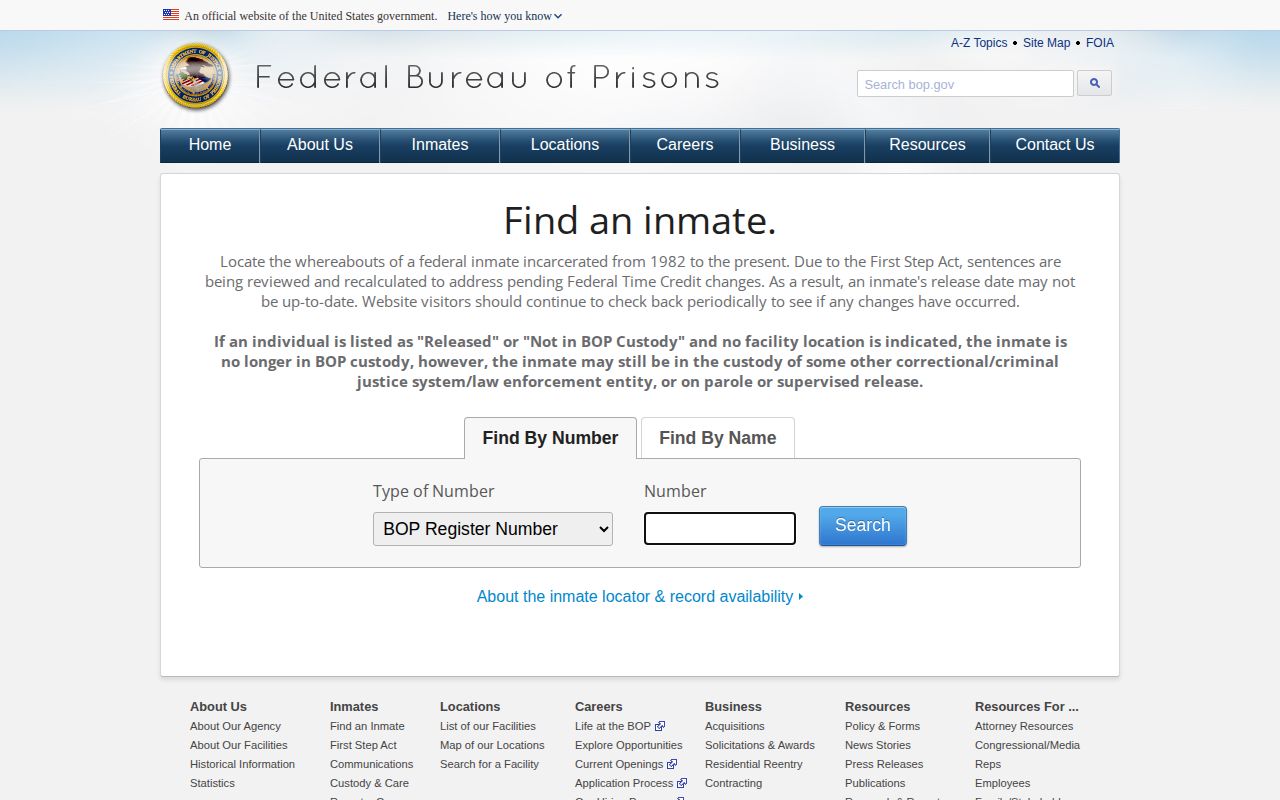
The locator is one part of the federal path. Its result should be read beside the case stage, register number, and any evidence of USMS or immigration custody.
Lee Federal Pretrial Custody
The U.S. Marshals Service prisoner program manages many federal defendants from arrest through court and transport to BOP. USMS often uses state, local, or private contract detention space. A person can therefore be held far from Lee County without appearing as a current BOP inmate. Absence from the county roster and BOP locator does not close this gap.
Use the federal docket to identify the prosecuting district, case number, detention order, sentence, and commitment stage. Then contact the relevant district’s public channel or detention provider for general custody routing. Do not ask for or publish live transport details. If sentencing has occurred, allow for movement and intake before assuming a BOP locator result should already appear.
A federal court order documents legal authority and case action. It may not record the exact physical release time. Keep those events separate. If a detention order was revoked or a sentence imposed, confirm the custodian’s completed event rather than turning the court timestamp into a jail-door time.
Check Lee Immigration Detention
The ICE Online Detainee Locator searches adults in immigration detention. An A-number search requires the person’s country of birth. A biographical search requires exact identifying information. The system does not publish juvenile records. When a matching result directs the user to an Enforcement and Removal Operations office, follow that official routing for clarification.
Immigration detention and a criminal case are distinct legal systems. A Lee County detail showing transfer to another agency can be a cue to check ICE, but it does not prove that ICE accepted custody. Likewise, a person who does not appear in ODLS may require ERO follow-up and could be in criminal, state, local, USMS, or BOP custody instead. Use only facts supported by the handoff and case record.
- A-number
- An immigration identifier used with country of birth in ODLS.
- ERO
- ICE Enforcement and Removal Operations, the office that handles immigration detention routing.
- Detainer
- A request or notice tied to another authority; it does not itself describe a completed street release.
- Transfer
- A move between custodians while detention may continue.
Note: ODLS nonappearance is a negative search result, not proof of release, removal, or freedom from another custodian.
Lee Federal Release Records
Federal records do not use North Carolina Chapter 132. A request for BOP, USMS, or ICE records follows that agency’s federal FOIA and Privacy Act procedures and applicable access limits. Identify the person, register or A-number if lawfully available, agency, case, facility, and date range. Ask for a specific existing release or custody record instead of asking an agency to create a new explanation.
The federal docket remains important for public orders, judgments, detention decisions, and commitment information. The custodian’s record is better for the completed physical custody event. Protected personal information, security material, and records restricted by federal law will not be released like an ordinary public docket entry.
Federal custody routingBOP: use the Inmate Locator for sentenced custody
USMS: contact the district tied to the federal case
ICE: use ODLS and the responsible ERO office
Lee County: use the Sheriff record only for the local episode
No physical federal facility address is shown because research did not identify a BOP prison or designated ICE center in Lee County. Naming a nearby jail without proof of the actual placement would create a false custody claim.
Trace a Lee Federal Handoff
Start with the Lee County released detail when the person first left the county jail. Read How Released and Release Reason together. Record the release date and time, confining agency, docket, and any named receiving authority. The local record proves that Lee County custody ended; it does not prove a later federal release.
Next, identify the receiving class. Use BOP only for BOP coverage, the relevant federal case and USMS route for pretrial or transport custody, and ODLS for adult immigration detention. If the record instead supports an NCDAC transfer or another county hold, move to that system. NC SAVAN may report the local custody change, but federal notification can be separate.
Identity matching matters across federal systems. A common name may return several BOP records, while a spelling difference can hide the right one. Prefer a register number, A-number, docket, date of birth, age, and case-linked agency data. Keep each custody episode separate. If no match appears, report only that no matching record was located in the named system with those terms on that access date. Do not turn the negative search into a claim about the person’s location.
The Lee County released inmate search path explains how the local episode can be reconciled with court and receiving-agency records. Preserve source names and access dates when results conflict. Do not choose the earliest date or broadest label. A bond order, county handoff, federal intake, BOP release, and immigration event can each be valid dates for different stages.