
Understand Lee County Released Inmates
A release record marks the end of one custody episode. It does not settle every charge, prove that a case was dismissed, or show that no other agency holds the person. The Lee County Sheriff’s official system separates Current and Released records. Someone who has left the Lee County Detention Facility normally moves out of Current mode and into the Released dataset. That is why a missing name on the live jail roster is not proof of release. The correct confirmation is the released detail, which reports when the local episode ended and how the Sheriff recorded the exit.
Custody type controls the next step. A county jail release belongs first in the Lee County portal. A state-prison release from Sanford Correctional Center belongs in the North Carolina Department of Adult Correction, or NCDAC, Offender Search. A federal sentence belongs in the Bureau of Prisons locator, while an immigration detention question belongs with ICE. A transfer means one custodian released the person to another. It is not the same as release to the street.
Lee County Release Types Explained
The Sheriff identifies several routes out of the Lee County Detention Facility. Each route answers only what happened to that jail episode. Bond permits a person to leave while the court case continues. A court order supplies judicial authority for release, but the order and docket must be read to learn its legal effect. Sentence completion or time served ends the stated confinement. Payment of a fine and court costs can also be the recorded basis. An outside agency may withdraw a hold, or another agency may take custody.
| Release type | What it means | Best next source |
|---|---|---|
| Bond | The jail episode ended while the case remains open. | Lee released detail and eCourts docket |
| Court order | A judge authorized the release or changed custody. | Filed order, judgment, and Clerk |
| Sentence complete or time served | The listed term or custody episode ended. | Released detail and judgment |
| Fine and costs paid | The jail recorded payment as the release basis. | Released detail and court record |
| Program or probation pickup | A representative received the person under an arranged plan. | NCDAC supervision record or program contact |
| Agency transfer | Lee County custody ended, but another custodian took over. | Receiving county, NCDAC, BOP, USMS, or ICE |
“Discharge” can mean the end of custody or the end of a sentence, depending on the source. “Time served” means the court credited enough confinement to satisfy the term at issue. “Detainer” means another agency has asked the current custodian to hold or transfer the person. These terms should be tied to the field and agency that used them.
Note: An arrest or booking entry records an accusation and custody event, not a finding of guilt.
Lee County Release Record Fields
The official Lee County released grid provides a compact discovery record. It lists full name, age, race, sex, admit date, release date, and time in jail. Each row leads to a more detailed record. That detail is the stronger source because it joins the person, the exact custody episode, the exit time, the destination-style field, and the legal or administrative basis. Match more than a name. Local ID, date of birth, age, admit date, docket number, charge, and agency help distinguish people with similar names or multiple bookings.
| Field | What it shows |
|---|---|
| Full Name and Local ID | The displayed identity and county identifier for this episode. |
| Date of Birth, Age, Race, Sex | Identity details that help separate similar records. |
| Admit Date and Time | When Lee County recorded the start of the episode. |
| Release Date and Time | When the detention system recorded the local exit. |
| Time In Jail | The duration reported for that booking episode. |
| Confining Agency | The agency responsible for the displayed custody record. |
| How Released | The destination or manner of exit, such as street or another custodian. |
| Release Reason | The administrative or legal basis recorded for the exit. |
| Charge and Docket | The linked allegation and court case used for disposition checks. |
| Bond and Agencies | Bond terms plus charging and arresting agency data. |
The detail also includes height, weight, offense date, court type, bond type, and a booking photograph. The release date proves departure from the displayed Lee County episode. It does not prove that every charge ended or that the person avoided a transfer. The court docket supplies disposition. A receiving agency’s record supplies later custody.
Lee County Release Destination and Reason
Lee County’s split between How Released and Release Reason is unusually useful. The first can show where or how a person left. The second can state why staff completed the release. Reading only one field can produce the wrong conclusion. A transfer to another jurisdiction, for example, ends the Sheriff’s custody but does not put the person in the community. A street destination paired with a bond reason supports a much narrower finding: the local booking ended through a bond release while the charge proceeds in court.
Build a short event line when the fields are unclear: court or bond event, jail release timestamp, destination, receiving agency, and later custody status. Different systems can post at different times. Keep each source attached to the event it proves. The jail detail is primary for the physical Lee County exit. The filed order is primary for legal authority. NCDAC is primary for a state admission or discharge. VINELink shows what its automated feed reported, not an independent account of the door exit.
Does “released” mean the person is free? Not always. Lee County may have released the person to NCDAC, another county, adult probation, a program representative, federal authority, or immigration custody.
Request Lee County Release Records
Start with the official released detail and save or print it while the record is online. The Sheriff does not publish a fixed retention promise for the web grid. “View all” describes the records available at query time, not an archive term. When the episode is absent or a durable copy is needed, ask the Lee County Sheriff’s Office for the existing booking and release record. North Carolina Chapter 132 requires access at reasonable times and copies as promptly as possible, subject to lawful redaction and copy-cost rules.
- Identify the person and episode with the full name, date of birth or local ID if known, and an admit or release date range.
- Ask for the existing booking and release record, including admit and release timestamps, How Released, Release Reason, public receiving-agency data, charges, docket number, and booking photograph.
- Contact the Lee County Sheriff’s Office at 1401 Elm Street, Sanford, NC 27330, 919-718-4560. Detention administration is 919-718-4567.
- Ask which records custodian, email address, or current form accepts detention-record requests. No dedicated release-record form or fixed local fee was verified.
- Request the specific existing record. An agency need not create a new report or answer open-ended questions in place of producing records.
Chapter 132 generally limits ordinary copy charges to actual cost. Special service charges require the conditions set by law. Juvenile, sealed, expunged, protected identifying, investigative, and confidential correctional material can be withheld. An expunction is a court process that removes eligible records from ordinary public access. Eligibility varies by statute and outcome, so the North Carolina Judicial Branch expunction resource and the Lee County Clerk are the right sources.
Note: Keep the source URL, access date, exact field, and proof of error when asking the custodian for a correction.
When Lee County Releases Inmates
The Lee County Detention Facility release information publishes local processing windows. Bond releases are processed from 7:00 to 11:30 a.m., 1:00 to 4:30 p.m., and 6:00 p.m. to 6:00 a.m. Sentenced discharges generally occur from 7:00 a.m. to 9:00 p.m. on the discharge day unless the court directs otherwise. Those are operating windows, not a promise that a named person will walk out at their start.
Staff review files and paperwork in the order received. That work takes time. A judge’s order, bond transaction, database post, and physical exit may therefore have different timestamps. The facility does not discuss transport times for security reasons. Confirm completion through the released detail rather than arranging around an estimated door time. If another agency will pick up the person, the Sheriff’s local release timestamp still does not disclose when the next custodian will move or receive them.
Lee County Release Property and Funds
The Sheriff says clothing and property are returned when a person is released from the Lee County Detention Facility. Remaining account money follows a different schedule. It is returned during regular business hours, 8:00 a.m. to 5:00 p.m. Someone who exits overnight may therefore leave with personal property but still have a later step for funds. Confirm the current pickup process with detention administration before traveling.
This local rule also helps resolve a common records problem. If a release time, reason, or destination appears wrong online, preserve the detail before it changes. Note the field and supporting proof, then contact the Sheriff’s detention-record custodian. A third party cannot correct the county source. The same principle applies elsewhere: NCDAC corrects state offender data, the Clerk addresses docket data, and federal custodians address their own locator records.
Note: Property return and account-fund return are separate steps, especially when a release occurs outside the listed business hours.
Find Lee County Released Inmates
The official county portal is the best first source for a known Lee County jail stay. Open Released mode before entering a name. Compare age, admit date, charge, and any known identifier, then open the detail. For a recent window, choose Days and enter 1 for the last-day view or 3 for the last-three-days view. The results are built at query time, so save the detail used for confirmation.
- Search Lee County Released mode and open the individual record. Record Release Date, Release Time, How Released, and Release Reason.
- If the destination suggests state prison or supervision, search NCDAC by offender number or name and review the newest status and history.
- Use the docket number in eCourts Portal to read the disposition, judgment, and later orders. A jail release does not decide the charge.
- Use NC SAVAN or VINELink for a custody-change cross-check and future alerts. Re-register if a transfer creates a new custody record.
- For a federal sentence, use BOP and the federal case. For immigration detention, use ICE ODLS and the responsible ERO office.
- If no online record appears, test spelling and identifiers, then call detention or request the Lee booking and release record.
Do not match on name alone. Compound surnames, name order, misspellings, repeat bookings, and people with similar names can mislead. A useful match joins identity, date, custody episode, docket, and agency. If neither county nor NCDAC returns a result, state that no match was found in those named systems using the stated terms and date. Do not turn a negative search into a claim that no record exists.
Search Lee County Released Inmate Feed
Lee County maintains one flexible released dataset rather than separate permanent 24-hour and 72-hour lists. The Days search creates either window. The all-released grid adds column filters and links to individual details. It displays the records currently published, and no fixed update interval or online retention period has been stated. Live same-day entries can appear after staff finish processing, so the detail and direct custodian confirmation remain stronger than a quick scan.
The official feed interface shows how Lee County records can be filtered and opened:
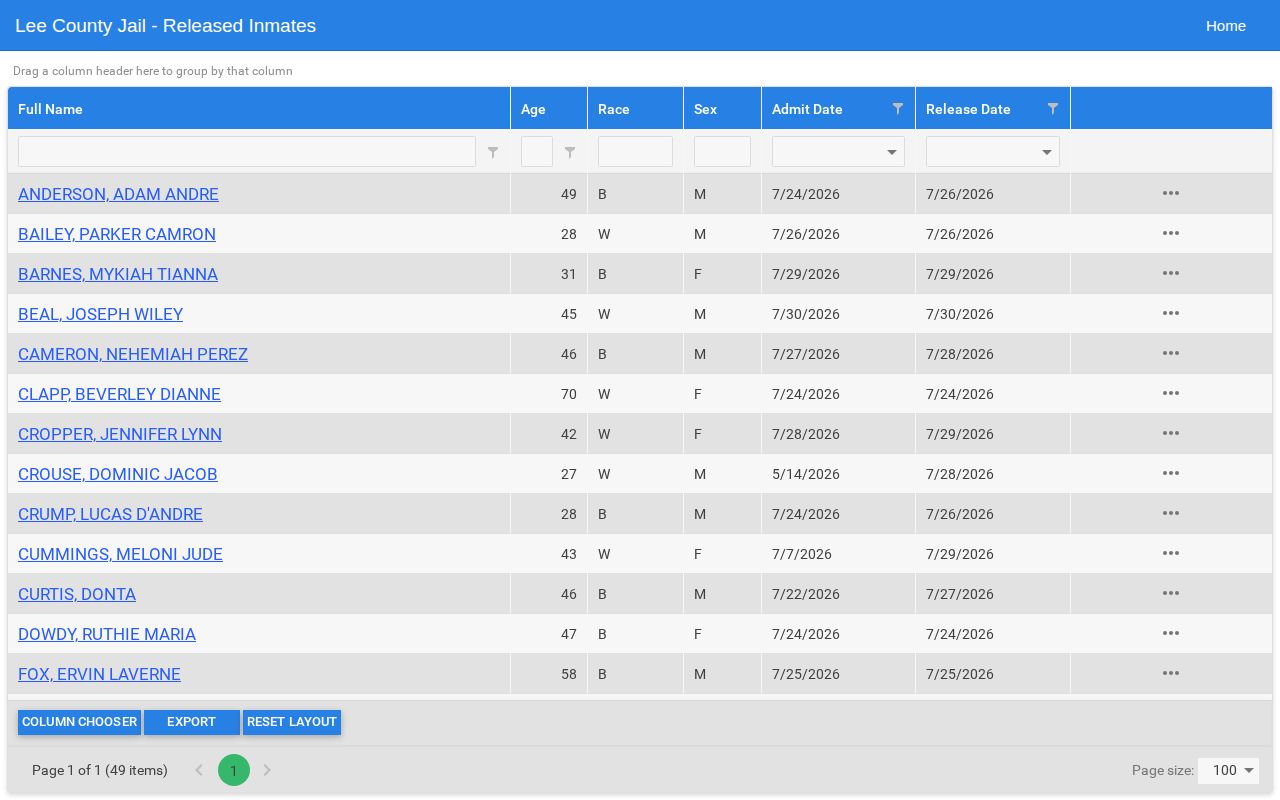
The grid is for discovery. The linked detail is for confirmation because it adds the exact time, destination, reason, local ID, docket, and charge context. Lee County has no verified Sheriff-branded jail app that publishes this feed. VINELink mobile access is a separate notification channel and should not be described as a county roster.
NCDAC Search for Lee County Releases
The NCDAC Offender Search covers current and historical North Carolina prison and Community Supervision information back to 1972. It does not cover a county-jail-only stay. Search by offender number when possible. Otherwise use name fields, then compare identity, conviction county, sentence data, and the newest custody episode. One profile may contain more than one admission, release, sentence, or supervision period.
| Search or record field | How to use it |
|---|---|
| Offender number | Best unique search key when known. |
| Name | Starting point that still requires identity checks. |
| Current status | Read with the newest incarceration and supervision events. |
| Admission and release history | Shows separate state custody episodes and completed releases. |
| Sentence components | Connects conviction and sentence terms to the state record. |
| Projected Release Date | A future estimate, not a guaranteed release or pickup time. |
| Community Supervision | Shows public history after prison or for probation cases where available. |
The state offender search form is distinct from the Lee County jail portal:
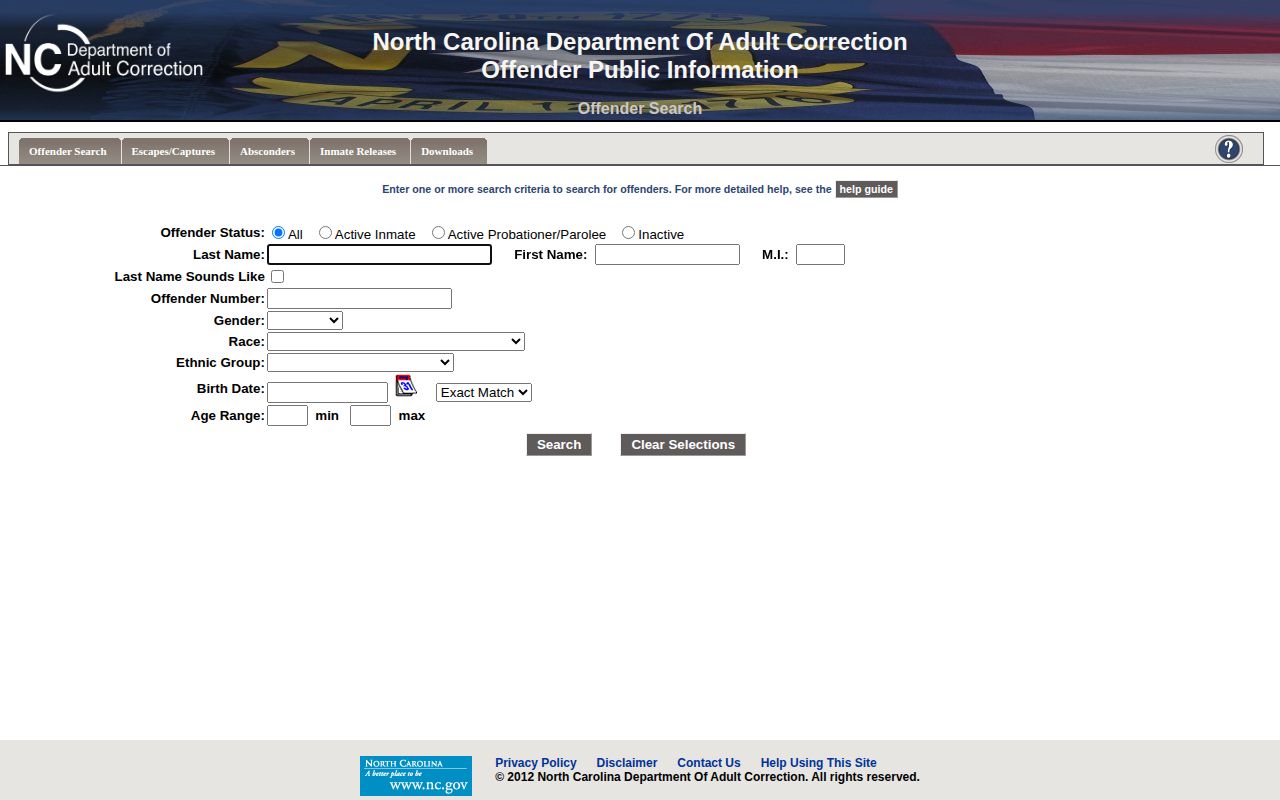
A completed state release event and a Projected Release Date answer different questions. The first is historical. The second can change after credits, amended judgments, disciplinary action, detainers, or recalculation. A release from prison may also start post-release supervision rather than end the sentence.
Note: NCDAC public basics include admission and release history, while internal prison and detailed supervision files can remain confidential.
Lee County eCourts Release Cross-Check
Lee County was among the first four North Carolina eCourts and Odyssey pilot counties in February 2023. That makes the modern eCourts Portal an important second source. Search by name or case number, select Lee County, and use the released detail’s docket number to make the match. The court record can show the filing, events, disposition, judgment, and public documents. It often lasts beyond the online life of a jail entry.
The jail and court records answer different questions. The released detail gives the operational exit time and manner. The judgment explains the legal outcome, such as dismissal, conviction, time served, active sentence, probation, or another result. A bond release usually occurs before disposition. A sentence-complete label may be checked against the judgment and confinement credit. If Portal lacks an older or public document, contact the Lee County Clerk of Superior Court at 1400 S. Horner Boulevard, Sanford, 919-718-6300.
Which date controls when sources disagree? Use the jail timestamp for the Lee County physical exit, the court order for legal authority, and NCDAC history for a state-prison release.
Lee County Release and Reentry Paths
Leaving custody can begin a period of supervision or service coordination. Parole is a conditional release available mainly under older or special North Carolina sentencing rules. Probation is a court-ordered community sentence or condition. Post-release supervision is the community portion that follows prison for covered felonies. Public NCDAC data may show Community Supervision history, while case notes and many detailed files remain confidential.
Lee County is served by the Chatham/Lee Local Reentry Council. County Community Support Services materials also describe RENEW and reentry coordination for people moving from jail or prison. Sanford Correctional Center is itself a reentry facility. These contacts are routes for asking about current services, not promises that a person will qualify for a specific benefit. Some Lee jail exits also require pickup by adult probation or a treatment or program representative, which is a supervised handoff rather than an ordinary street release.
The local probation and parole number published by the Sheriff is 919-776-0639. Confirm the person’s current assignment before an in-person visit. A concise treatment of status checks and supervision boundaries appears on the Lee County Probation & Parole page.
Sanford Release Records in Lee County
Sanford Correctional Center is a minimum-custody male NCDAC prison and reentry facility in Lee County. Its listed capacity is 298. Work release and off-site assignments mean a person may be seen in the community while still in state custody. Physical presence outside the prison does not by itself prove discharge.
Use NCDAC Offender Search for a Sanford custody or release question. Review the current status, incarceration history, newest state release event, sentence components, and Community Supervision history. A transfer to another NCDAC institution is not a community release. A prison exit to post-release supervision ends the prison portion but starts the supervised portion. The Lee County Sheriff portal is relevant only if a separate Lee jail booking also occurred.
- Release
- The end of the custody episode named by the record.
- Transfer
- A handoff from one authorized custodian to another.
- Discharge
- The end point reported for a custody or sentence status, read in source context.
- Post-release supervision
- A required community phase after the prison portion for covered sentences.
Lee County Release Systems Compared
Choose the system that owns the custody event. A current jail roster can show who is held now, but it cannot replace the released dataset. NCDAC can confirm state imprisonment and public supervision history, but it has no county-jail-only record. NC SAVAN and VINELink provide alerts and cross-checks, yet an alert can reflect a transfer. BOP and ICE each cover only their own federal custody class.
| Question | First source | Key limit |
|---|---|---|
| Held in Lee jail now? | Lee Current mode | A missing name does not prove release. |
| Left Lee jail? | Lee Released detail | Does not prove freedom from all custodians. |
| Left North Carolina prison? | NCDAC Offender Search | Does not include jail-only stays. |
| Charge outcome? | eCourts Portal and Clerk | May not show the jail-door time. |
| Custody alert? | NC SAVAN or VINELink | Feeds can lag, and transfers need care. |
| Left federal prison? | BOP Inmate Locator | “Not in BOP custody” is not “not detained.” |
| In ICE custody? | ICE ODLS and ERO | Separate from the criminal case and adult records only. |
The BOP Inmate Locator covers federal records from 1982 forward and may show Released with a date. USMS may control a federal defendant before BOP commitment. ICE ODLS uses an A-number and country of birth or exact biographical data. None of these tools should be substituted for the Lee County released detail when the question is only whether a local jail episode ended.
Lee County Release Facilities
Three custody paths serve Lee County, and each has its own release record. The primary county jail posts its own released details. The state prison uses NCDAC. Federal and immigration cases may involve facilities outside the county, so the federal custodian and court control the later status.
- Lee County Detention Facility: county jail releases go to the official Lee Released detail, with court and receiving-agency checks as needed.
- Sanford Correctional Center: state-prison release, transfer, discharge, and supervision history belong in NCDAC Offender Search.
- Federal facilities serving a Lee County case: use BOP for sentenced federal custody, USMS context before commitment, and ICE ODLS for immigration detention.
Where the person goes matters as much as the release date. A street exit, supervision handoff, treatment pickup, county transfer, NCDAC admission, federal move, or ICE handoff calls for a different final check. Preserve the Lee detail, then follow the named receiving system.