
Lee County Projected Versus Actual
A projected date is a current calculation based on the controlling judgments, sentence structure, prior-custody credit, earned time, discipline, and the law that applies to the sentence. It can move. An actual release is a completed event recorded after custody changes. In the Lee County jail system, that completed event appears in Released mode with an admit and release timestamp, “How Released,” and “Release Reason.” In the state system, NCDAC incarceration history and current status document the state event.
Physical release can also begin supervision rather than finish every part of a sentence. Post-release supervision places a person in the community under NCDAC rules after the prison portion. Parole is conditional release under an older or special sentencing law. Probation is court-ordered community supervision and may occur without a prison release. A transfer ends one facility's custody but is not community release.
A pretrial detainee usually has no sentence-based projected date. Bond may be posted, a judge may change conditions, charges may be resolved, or another agency may lodge a detainer. For that person, follow the court docket and the Lee County current/released portal instead of applying a sentence calculator.
Find a Lee County Projection
Start by identifying the custodian. Lee County Detention Facility is operated by the Sheriff. Sanford Correctional Center is an NCDAC state prison, even though it stands in Lee County. A person sentenced in federal court follows the federal path. Searching the wrong database can produce a valid “no result” while the person remains in another system.
- Check the Lee County current and Released selector to determine whether the county jail holds or recently released the person.
- For a state prisoner, open NCDAC Offender Search and search by offender number when possible, or by name.
- Confirm identity from offender number, age or birth information, convictions, and custody history before reading any date.
- Read the exact “Projected Release Date” label when it appears. Do not substitute a custody review date, maximum date, or supervision end date.
- For a county sentence, compare the judgment in the eCourts Portal with the jail's calculation or request the existing release record.
The NCDAC public-records office can supply basic public sentence, admission, and release information when the web result is unclear. Internal prison and Community Supervision files are restricted. For the Sheriff, ask specifically for the sentence-calculation or release record for the named booking episode. Chapter 132 does not require an office to create a new calculation in response to a question.
The official NCDAC form below is the state search entry point. Visit the North Carolina offender search and verify the correct record before using a projected date.
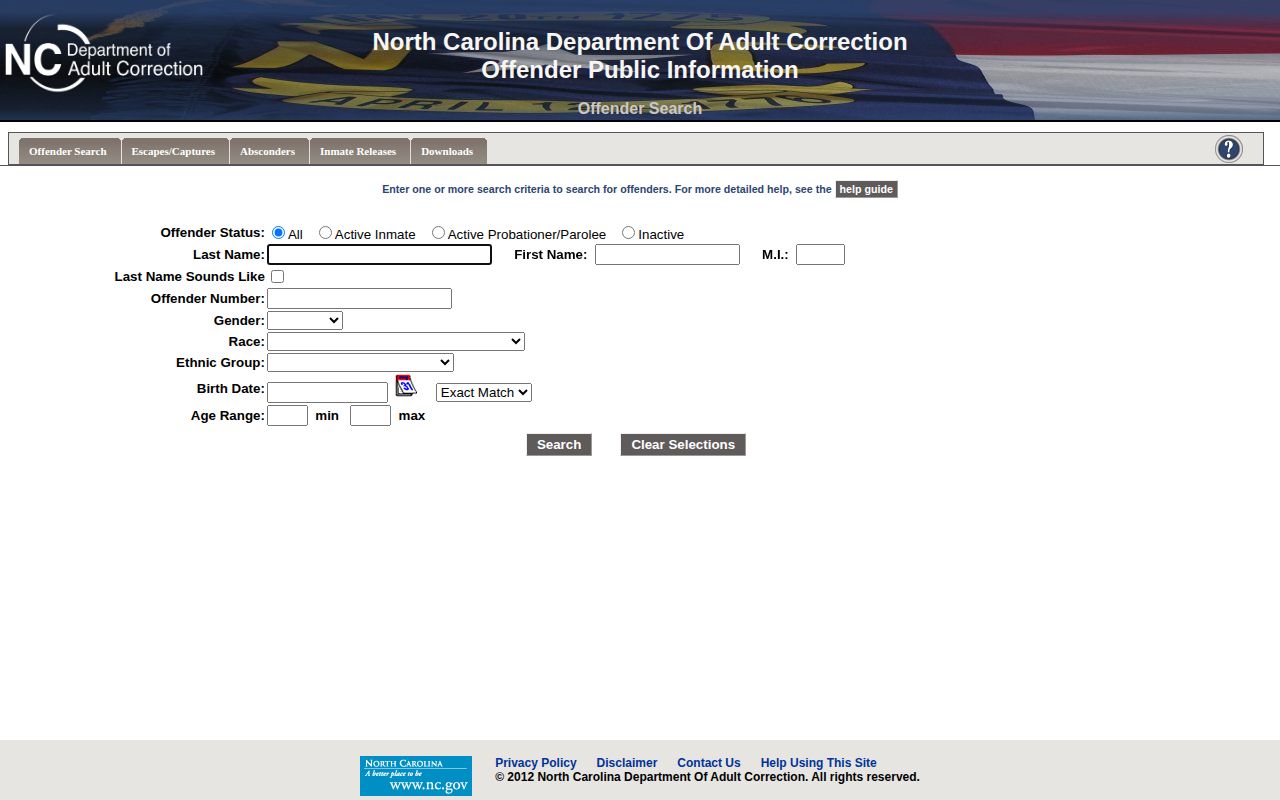
The public form searches state imprisonment and supervision history, not Lee County jail-only stays.
North Carolina Felony Release Rules
Modern North Carolina felonies use Structured Sentencing. Under G.S. 15A-1340.13(d), the prisoner must serve the minimum term, subject to the statute's specific exception. Earned time may reduce the maximum, but not below that minimum. This is more accurate than applying a free-floating “85 percent” rule.
The judgment's offense class, prior-record level, chosen range, enhancements, consecutive terms, sentence date, credits, and discipline can change the controlling calculation. Two sentences described casually as the same length may produce different dates. NCDAC's public projection is therefore more reliable than private arithmetic built from a news story or docket summary.
For covered felonies, G.S. 15A-1368.2 governs release to post-release supervision. Physical release from prison occurs within that sentence structure, before the maximum endpoint by the applicable supervision interval and earned-time rules after the minimum has been served. A posted prison-exit date does not necessarily mean the entire sentence or supervision obligation ended.
Why Lee County Dates Change
A projection reflects the facts known to the custodian at that time. New credit, a corrected judgment, disciplinary forfeiture or restoration, and a new consecutive sentence can change the calculation. An outside detainer may change where the person goes even when the original release date remains valid for the first custodian.
| Factor | Effect on the record |
|---|---|
| Prior-confinement credit | Credit under G.S. 15-196.1 can reduce time remaining on the same charge or incident. |
| Earned time | Qualifying credit can reduce the controlling term within statutory limits. |
| Discipline | Forfeiture or restoration may move a state projection. |
| Corrected court order | An amended judgment or clarified sentence changes the inputs. |
| Consecutive sentence | Multiple terms may be aggregated rather than ending independently. |
| Detainer or transfer | Custody with one agency may end while another agency immediately takes control. |
Parole is not an ordinary shortcut for modern Structured Sentencing cases. The Post-Release Supervision and Parole Commission says ordinary discretionary parole mainly concerns older pre-October 1994 sentences and narrow statutory categories. Its monthly discretionary review reports are case-review records, not a public hearing calendar or a promise of release.
Confirm Lee County Release Dates
After the projected day, return to the source. For the Lee County jail, select Released and open the individual detail. Its timestamp establishes when the county episode ended, while “How Released” and “Release Reason” show whether the event was street release, a program or supervision pickup, or a handoff. For Sanford Correctional Center, check NCDAC current status and incarceration history.
The Lee County VINELink inmate search can provide a custody-change alert. NC SAVAN covers North Carolina jails and Adult Correction, but an alert is still a prompt to verify. A transfer may require registration with the receiving agency. Federal release uses BOP, court, or U.S. Marshals channels rather than VINELink.
When dates conflict, make a short chronology. Label the court order date, bond-posting time, jail release timestamp, state prison release, supervision start, and alert-transmission time separately. The Lee jail detail is primary for the physical county-jail departure; the judgment is primary for legal authority; NCDAC history is primary for a state-prison event.
Lee County Misdemeanor Credit
Local misdemeanor calculations follow a different path from state felony projections. G.S. 15A-1340.20(d) caps earned time at four days per month. G.S. 162-60 describes four days for each 30 days of faithful qualifying work or education, rehabilitation, or training. The custodian decides whether participation was faithful.
That is not an automatic four-day monthly reduction. Program participation, posted credit, forfeiture, the sentence law, and prior custody all matter. The Sheriff does not publish an online Lee County jail release calculator. Ask for the actual record instead of estimating from the sentence length.
The jail says sentenced releases generally process from 7 a.m. to 9 p.m. on the discharge day unless the court directs otherwise. That window describes operations, not how the date was calculated. A person may leave later than the legal authorization because records, property, pickup, or a receiving agency must be processed.
Older Lee County Parole Sentences
North Carolina parole law remains relevant to older sentencing regimes and narrow categories. The eligibility rules in G.S. 15A-1371 include distinctions for older Fair Sentencing cases, impaired-driving sentences, and statutory exceptions. A person with life without parole is not converted into an eligible case by a general release-date estimate.
The Commission does not conduct a routine formal offender hearing or meet personally with the person under review. Its Monthly Discretionary Parole Reviews page publishes reports beginning in September 2024. Those reports describe review outcomes such as incomplete or suspended decisions and types of parole. They are not a calendar of guaranteed exits.
A custody review date in a state profile should not be relabeled as a projected release date. Read the field name exactly. If an eligible older case is under review, the Commission decision, NCDAC status, and eventual incarceration history must be reconciled before reporting release.
Resolve Lee County Date Conflicts
Conflicting dates often describe different events. A court order authorizes action. A bond-posting time records payment or execution. The jail release timestamp records the end of the Lee County episode. A transfer time records the handoff. A state prison release may mark the start of post-release supervision, while a later date ends supervision. VINELink reports when an automated system sent notice.
Build a dated list with one source and one event per line. For a Lee jail departure, use the Released detail as the primary operational record. For legal authority, use the filed judgment or order. For a Sanford Correctional Center exit, use NCDAC incarceration history and current status. For notification, preserve the alert without treating it as the custodian's master record.
If two sources truly claim different times for the same event, save both URLs and access times. Ask the responsible custodian for correction or explanation. The Lee County Sheriff's Office handles its jail data; NCDAC handles state calculations; the Lee Clerk handles the docket. A third-party estimate cannot correct any of those source systems.
Future dates should always retain the word “projected.” After the day passes, look for an actual release, discharge, transfer, or supervision event. If no event appears, do not turn silence into a conclusion. Recheck the source, test identity details, and use the records-request channel when the public interface no longer supplies enough history.
A court case number is a useful bridge between the jail and judgment. It helps the Clerk locate the filed order and helps the Sheriff identify the related booking episode. Still compare the person's identifiers and dates. One docket can have several hearings, while one jail stay can involve more than one charge.
For a federal sentence connected to Lee County, use the BOP Inmate Locator. Its public coverage begins in 1982 and may show “Released,” a release date, or “Not in BOP custody.” The last phrase does not prove the person is free, because U.S. Marshals, immigration, state, or local custody may still apply.
ICE custody follows a separate locator and legal process. A Lee County transfer field can signal the need to check a receiving agency, but it cannot supply an immigration release date. Match the question to the custodian before comparing dates.
Public Record Search
Sponsored Results