
Lee County Three-Day Release View
Lee County uses one official dataset for all released jail records. The Released search landing page lets a user select Days and enter any number. Entering 3 generates the rolling 72-hour result. There is no separate county PDF or fixed three-day report.
This wider span is useful for catch-up work. It can show releases that have already moved outside a one-day query. Yet it is still a moving window. Its edges depend on the current query time, the recorded release time, and when the detention system posts the event. An entry seen early in the day may fall outside the view later.
Check Lee County 72-Hour Releases
The search should begin in Released mode. Current mode answers a different question and may omit the person because the jail episode has ended. Use several identity fields before accepting a match.
- Open the Lee County Current/Released Inmate Search.
- Select Released, then choose the Days search option.
- Enter 3 to form the rolling last-three-days window.
- Compare name, age, sex, admit date, charge, and release date for the likely record.
- Open the detail and read Release Date, Release Time, How Released, Release Reason, and docket information.
The detail should drive the conclusion. Disappearance from Current is not enough. A spelling difference, a new booking number, medical movement, data lag, or transfer can also produce a missing current result. For only today’s departures, narrow the query through the Lee County 24-hour release list.
When the identity is uncertain, use local ID, date of birth or age, docket number, and admit date. Names can be reordered, misspelled, or shared by more than one person. Note: Save the query date and time so the rolling three-day result can be understood later.
Lee County 72-Hour Record Fields
The all-released grid gives table filters and links to each individual history. A three-day result uses the same underlying records. The table fields help identify the episode; the detail explains the precise exit.
| Field | Use in a three-day check |
|---|---|
| Full Name, Age, Race, Sex | Compare the person without relying on name alone |
| Admit Date | Identify which booking episode ended |
| Release Date | Place the exit within or outside the three-day span |
| Days or Time In Jail | Understand the duration attached to that episode |
| Release Time | Resolve the event near a rolling-window boundary |
| How Released | Read the destination or custody handoff |
| Release Reason | Read the administrative or legal basis |
Individual records may also include Local ID, date of birth, physical descriptors, confining agency, and a charge grid with docket, bond, charging agency, and arresting agency. The grid shown below comes from the official Lee County released feed.
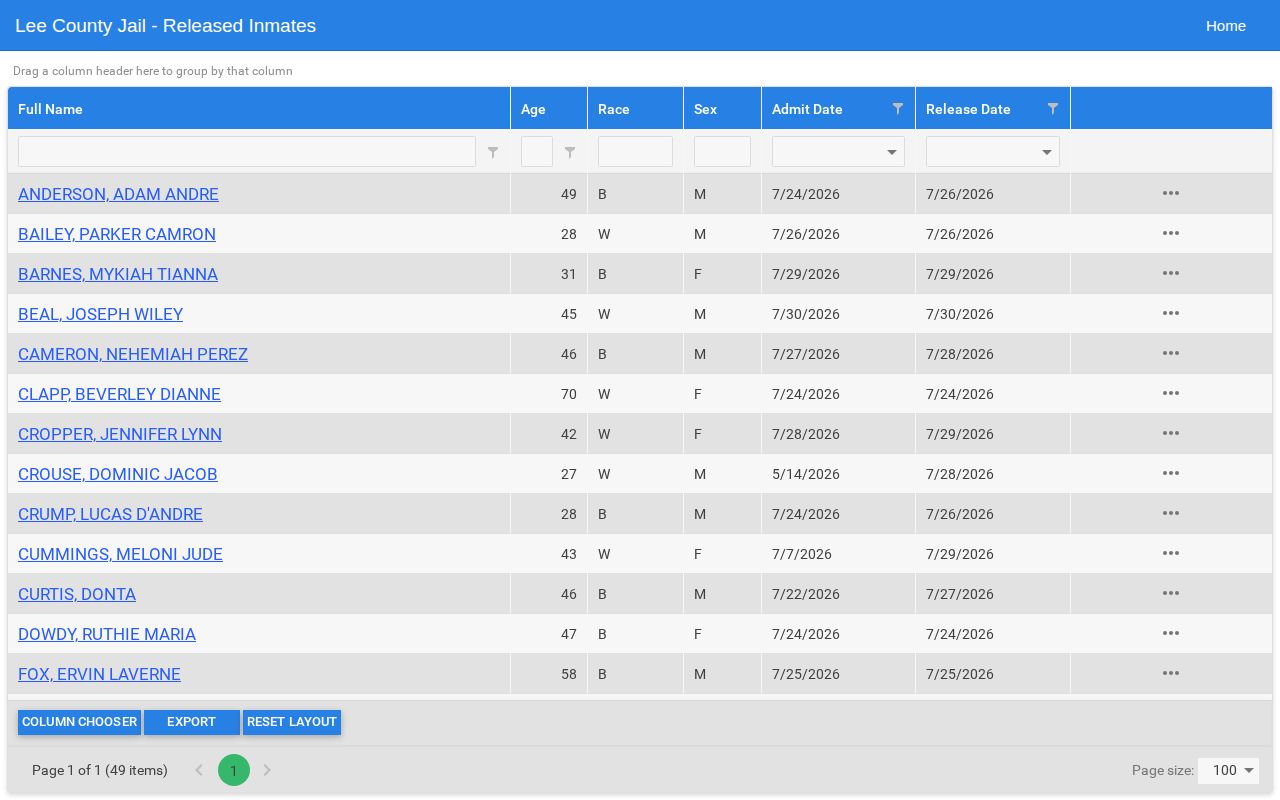
The screen’s date filters and linked details make it possible to verify a multi-day span without relying on a saved list of names.
Why Lee County Builds the Window
Lee’s roster is not a fixed “last 72 hours” file. The user creates the span at query time by placing three in the Days control. The all-released grid then provides more date filters and individual histories. This setup is flexible, but it changes how the result should be cited.
A sound record says that the name appeared in the Lee County Released search for a three-day query at a stated access time. It should not say the Sheriff issued a dated three-day bulletin. Nor should “View all” be treated as a retention promise. The portal does not publish how long each released detail will remain online.
For a record that must survive beyond web availability, request the booking and release record from the Sheriff. Include name, date of birth, Local ID if known, and a useful booking or release range. The public court docket can preserve the legal case history even when a jail web entry is no longer easy to locate.
Lee County Weekend Release Checks
A three-day query often crosses a weekend or holiday, but the research does not establish a special weekend publication schedule. It is safer to use the actual timestamps than to presume that all weekend entries arrive in one batch. Staff process files in received order, and the Sheriff warns that the review takes time.
Bond releases have published operating windows. Sentence discharges generally occur during the Sheriff’s stated daytime and evening span on the discharge date unless a court says otherwise. Those windows do not guarantee when one person will leave. A court order time, bond-posting time, jail release timestamp, and automated notification time may all differ because each describes a different step or system.
Build a short chronology when dates conflict. For the physical end of Lee County jail custody, the detail’s Release Date and Release Time are the primary operational fields. For the legal authority, use the court order or judgment. For an alert, VINELink proves that its automated system reported an event, not the exact door time.
Lee County Release Is Not Freedom
The county detail’s two release fields are vital over a three-day scan. How Released may describe a street exit or another custodian. Release Reason describes why Lee County closed the episode. A transfer ends local custody but does not end custody as a whole.
| Reported event | Next source | Safe conclusion |
|---|---|---|
| Release to street | Lee detail and court docket | The local episode ended in community departure |
| Transfer to NCDAC | NCDAC Offender Search | State custody may have begun |
| Adult probation pickup | NCDAC public supervision history and office | A supervised handoff occurred |
| Another agency | Receiving county, federal, or immigration custodian | Lee custody ended, but other custody may continue |
A bond release also does not decide the charge. Search the eCourts Portal by docket or person and select Lee County to review public case events and disposition. A charge caption is not a conviction.
Lee County Release Verification Channels
The three-day feed is strongest for a recent Lee County Detention Facility exit. It is not a single answer for every person connected to Lee County. Select the next channel from the custody episode and from the detail’s destination field.
- Sheriff records: request the booking and release record when the web entry is missing or a durable copy is needed.
- Lee County court: use the docket and judgment to learn what happened to the charge, since jail release does not decide guilt or disposition.
- NCDAC: search state incarceration and Community Supervision when the person transferred to state custody or served a prison sentence.
- NC SAVAN: register for reported custody changes, then re-register after a transfer when the new agency record requires it.
- Federal custodian: use BOP, USMS context, or ICE only when the case or county detail supports that handoff.
These systems can show different dates because they record different events. Label each date by source and event rather than choosing the earliest one as the release time. This keeps the three-day jail result tied to the custody episode it can actually prove.
Confirm Older Lee County Releases
When a person is absent from the three-day result, test spelling variants and search by name or charge in Released mode. Then decide which custodian could hold the relevant record. A state-prison discharge appears in the NCDAC Offender Search, which does not contain county-jail-only stays. Federal and immigration custody use different systems.
Call the Lee County Detention Facility at 919-718-4567 for its records process. The Lee County Clerk at 919-718-6300 handles public court files. NC SAVAN/VINELink can serve as a custody-change alert and cross-check, but a transfer may require re-registration and direct confirmation with the receiving agency.
Do not turn a negative search into a claim that no release occurred. State which system, terms, and date were checked. The broad Lee County released inmates record paths help route a named-person search when the three-day feed is not the correct custody source.