
Lee County 24-Hour Release Search
The Lee County Sheriff’s official Released search does not publish a separate static page labeled “24 hours.” It provides a Days tab. Entering 1 creates a rolling view for the last day at the time of the query. The result comes from the detention system’s released dataset, so it is more direct than treating a missing name on the current roster as proof of release.
The window moves with the query time and with data posting. It is not a midnight-to-midnight daily report. Someone whose release falls near the edge can appear on one check and fall outside the next. Save the access time and open the individual detail when a result matters. The broader all-released grid also has date filters, pagination, and links to each release history.
Check Lee County Releases Today
Use the official Lee County release mode first for a person who passed through the Lee County Detention Facility. Name spelling and the selected custody mode both affect the result. A search left in Current mode can miss the person for the exact reason being checked: the booking episode has ended.
- Open the county Current/Released Inmate Search and select Released.
- Choose the Days option and enter 1 to create the rolling last-day window.
- Compare name, age, sex, admit date, charges, and release date. Do not match on name alone.
- Open the detail record. Record Release Date, Release Time, How Released, Release Reason, and the docket number.
- Use the docket in the North Carolina eCourts Portal when the case outcome or court order must also be confirmed.
A person who is not found may have a spelling variation, a different booking episode, a state-prison record, or a transfer to another custodian. For one named person across systems, the complete release paths remain on the Lee County released inmates search. Note: Record the query time because the one-day window changes continuously and is not a saved daily roster.
Lee County Release List Fields
The results table gives a useful first view, but the detail is the stronger confirmation. Lee County splits the destination-style field from the administrative reason. That distinction helps prevent a transfer from being called a community release.
| Official field | What it establishes |
|---|---|
| Full Name, Age, Race, Sex | Identity clues for matching the correct record |
| Admit Date | Start of the listed Lee County jail episode |
| Release Date and Time | Recorded exit timestamp for that episode |
| Time In Jail | Duration shown by the detention record |
| Confining Agency | Agency tied to the custody episode |
| How Released | Destination or type of physical handoff |
| Release Reason | Administrative or legal basis recorded by staff |
The charge grid may also show charge, offense date, court type, docket number, bond, bond type, charging agency, and arresting agency. A charge is not a conviction. The court docket is needed for disposition. The county table shown in the official released feed is illustrated below.
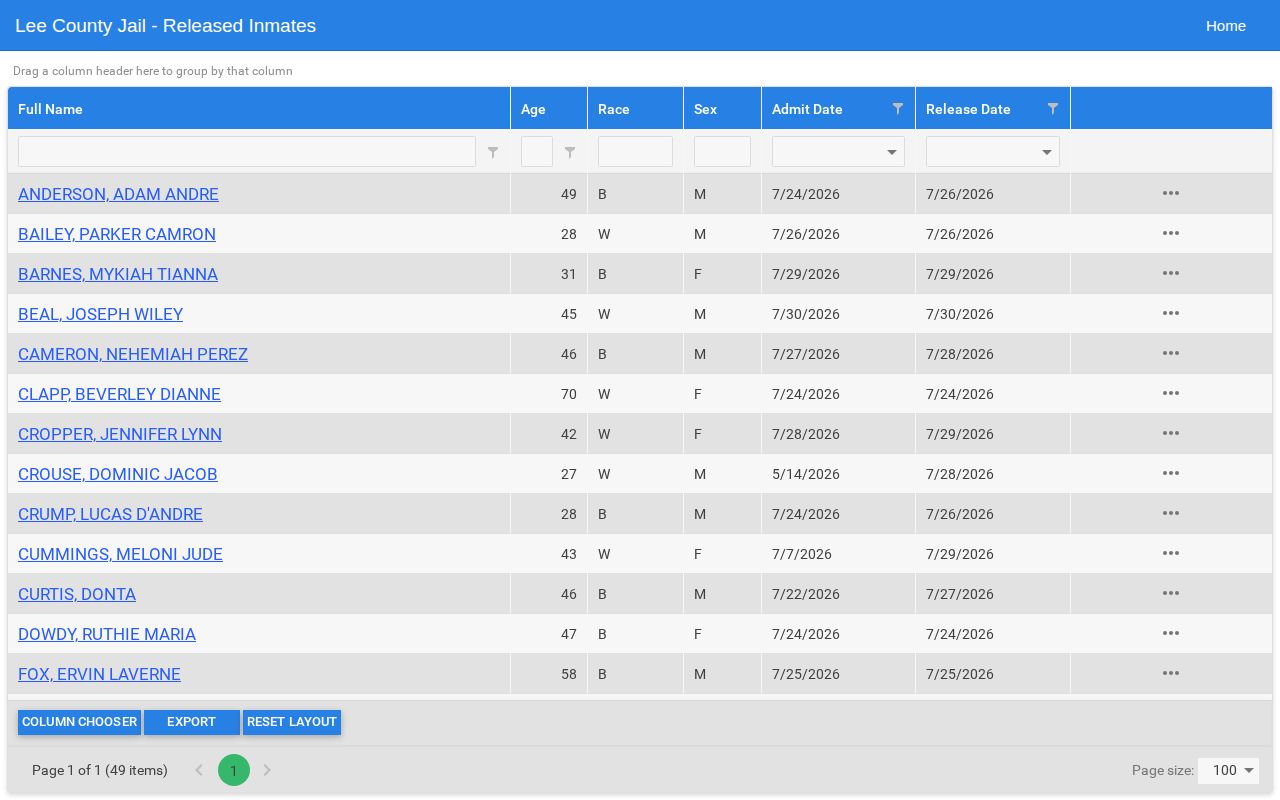
The filter controls and release columns support a same-day check without turning a current-custody roster into a release record.
When Lee County Processes Releases
The Lee County Detention Facility release information publishes unusually specific processing windows. Bond releases are processed from 7:00 to 11:30 a.m., 1:00 to 4:30 p.m., and 6:00 p.m. to 6:00 a.m. Sentence discharges generally occur from 7:00 a.m. to 9:00 p.m. on the discharge day unless the court directs otherwise.
These are operating windows, not an appointment or promised door-exit time. Staff review paperwork and file information in the order received. The Sheriff describes that review as thorough and time-consuming. Bond posting or a judge’s order can therefore occur before the release timestamp appears. Security rules also mean staff will not discuss transport timing. Check the completed detail rather than calculating an exit from the start of a window.
Different release routes require different paperwork. Bond, a court order, sentence completion, fine and costs, release of another agency’s hold, and a transfer are not interchangeable. A person may also leave through pickup by adult probation or a designated program representative. Note: A listed processing range never proves that all legal holds have cleared or that release is complete.
Lee County Release Destination and Reason
Lee County’s two-field design answers two separate questions. How Released can describe where the person went or how custody ended. Release Reason records the cause used in jail administration. Both should be read together.
- Street release
- The record supports departure from Lee County custody into the community, subject to any separate supervision obligation.
- Transfer
- Lee County custody ended because another authorized agency received the person. Physical custody continues.
- Bond
- The jail episode ended while the criminal case continues. Bond is not dismissal.
- Program or probation pickup
- The exit involved an arranged handoff, not an ordinary unassisted departure.
If the receiving agency is NCDAC, use the NCDAC Offender Search. A federal or immigration handoff requires the proper federal custodian. NC SAVAN can report a custody change, but its transfer warning means an alert must still be checked against the county detail.
How Lee County Builds 24-Hour Results
The Days control makes the one-day view when the search runs. It does not retrieve a saved report with a fixed issue time. This matters near the cutoff. A release timestamp that is just under 24 hours old can appear, while the same record may leave the result soon after. A new entry can also arrive after staff complete the underlying release work.
The direct all-released grid offers another way to inspect the data. Its date columns can be filtered, and each row opens the person’s detail. Use that grid when the rolling Days result needs a closer timestamp check. Neither view states a permanent archive period. For a lasting copy, request the existing record from the Sheriff rather than assuming the web entry will remain.
Describe the evidence precisely: “The official Lee County Released search returned the record in a one-day query at the stated time.” That wording reflects how the portal works. It avoids claiming that the Sheriff published a stand-alone daily bulletin.
Lee County Released or Transferred
A released entry proves the end of one Lee County Detention Facility episode. It does not by itself prove that the person is free from every custodian. The receiving agency, court case, and supervision status may each tell a different part of the timeline.
| Situation | Best confirmation |
|---|---|
| Left Lee County jail | Lee released detail and its exact timestamp |
| Still booked in Lee County | Current mode in the Sheriff search |
| Transferred to state prison | NCDAC current status and admission history |
| Released with a case pending | Lee detail plus the eCourts docket |
| Custody-change notification | NC SAVAN/VINELink, then direct custodian check |
NC SAVAN/VINELink can provide coverage and notification. Re-register after a transfer when the receiving record requires it. The county’s one-day view is retrospective: it confirms what staff posted after an exit. It is not a projected schedule.
Missing Lee County Same-Day Records
If the same-day query has no match, widen the spelling and verify that Released mode is active. Then use the three-day view, which can catch a record near the rolling cutoff or an entry posted after processing. The Lee County 72-hour release list uses the same official dataset with a wider window.
For direct confirmation or an older record, call the Lee County Detention Facility at 919-718-4567 and ask for the records process. A narrow public-record request should identify the person, date of birth, local ID if known, and an admit or release date range. The Sheriff’s released grid has no published retention promise. “View all” describes an available view, not a permanent archive.
The Lee County Clerk of Superior Court at 919-718-6300 can help with the public case record. A state-prison release belongs in NCDAC, not the county jail feed. These routes preserve the line between a missing web result and a factual claim that no record exists.